
Types of Operating Systems
Following are some of the most widely used types of Operating system.
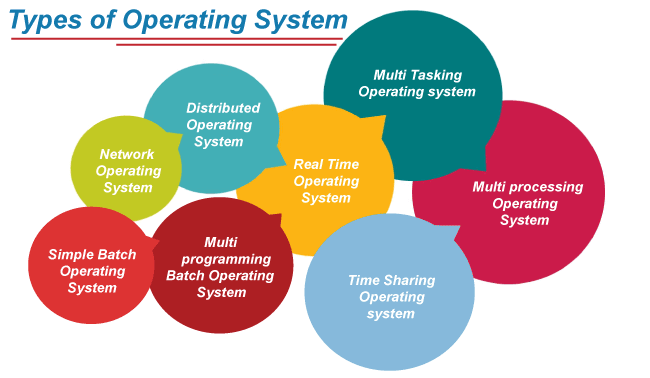
1. Simple Batch System
2. Multiprogramming Batch System
3. Multiprocessor System
4. Distributed Operating System
Simple Batch Systems
- In this type of system, there is no direct interaction between user and the computer.
- The user has to submit a job (written on cards or tape) to a computer operator.
- Then computer operator places a batch of several jobs on an input device.
- Jobs are batched together by type of languages and requirement.
- Then a special program, the monitor, manages the execution of each program in the batch.
- The monitor is always in the main memory and available for execution.

Advantages of Simple Batch Systems
- The use of a resident monitor improves computer efficiency as it eliminates CPU time between two jobs.
Disadvantages of Simple Batch Systems
1. Starvation
Batch processing suffers from starvation.
For Example:
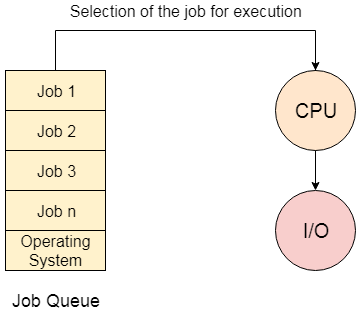
There are five jobs J1, J2, J3, J4, and J5, present in the batch. If the execution time of J1 is very high, then the other four jobs will never be executed, or they will have to wait for a very long time. Hence the other processes get starved.
2. Not Interactive
Batch Processing is not suitable for jobs that are dependent on the user’s input. If a job requires the input of two numbers from the console, then it will never get it in the batch processing scenario since the user is not present at the time of execution.
Multiprogramming Batch Systems
- In this the operating system picks up and begins to execute one of the jobs from memory.
- Once this job needs an I/O operation operating system switches to another job (CPU and OS always busy).
- Jobs in the memory are always less than the number of jobs on disk(Job Pool).
- If several jobs are ready to run at the same time, then the system chooses which one to run through the process of CPU Scheduling.
- In Non-multiprogrammed system, there are moments when CPU sits idle and does not do any work.
- In Multiprogramming system, CPU will never be idle and keeps on processing.

Time Sharing Systems
These are very similar to Multiprogramming batch systems. In fact time sharing systems are an extension of multiprogramming systems.
In Time sharing systems the prime focus is on minimizing the response time, while in multiprogramming the prime focus is to maximize the CPU usage.

Multiprocessor Systems
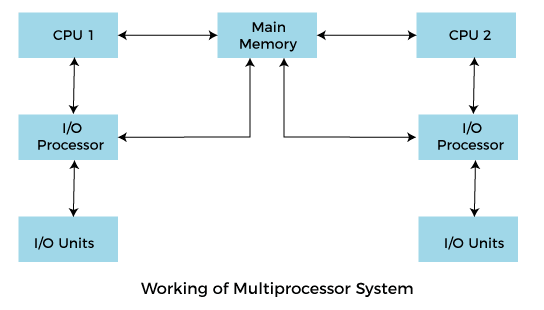
A Multiprocessor system consists of several processors that share a common physical memory. Multiprocessor system provides higher computing power and speed. In multiprocessor system all processors operate under single operating system. Multiplicity of the processors and how they do act together are transparent to the others.
Advantages of Multiprocessor Systems
1. Enhanced performance
2. Execution of several tasks by different processors concurrently, increases the system’s throughput without speeding up the execution of a single task.
3. If possible, system divides task into many subtasks and then these subtasks can be executed in parallel in different processors. Thereby speeding up the execution of single tasks.
Distributed Operating System
The motivation behind developing distributed operating systems is the availability of powerful and inexpensive microprocessors and advances in communication technology.
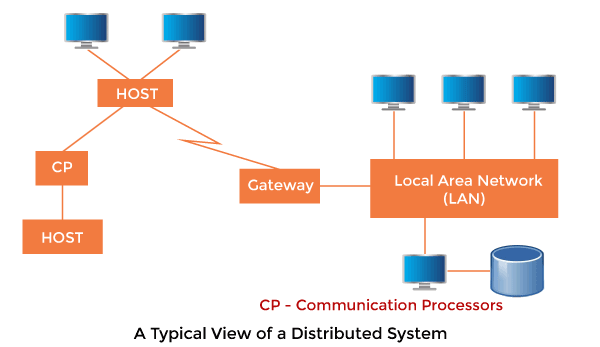
These advancements in technology have made it possible to design and develop distributed systems comprising of many computers that are inter connected by communication networks. The main benefit of distributed systems is its low price/performance ratio.
Advantages Distributed Operating System
1. As there are multiple systems involved, user at one site can utilize the resources of systems at other sites for resource-intensive tasks.
2. Fast processing.
3. Less load on the Host Machine.
Types of Distributed Operating Systems
Following are the two types of distributed operating systems used:
1. Client-Server Systems
2. Peer-to-Peer Systems
Client-Server Systems
Centralized systems today act as server systems to satisfy requests generated by client systems. The general structure of a client-server system is depicted in the figure below:
Server Systems can be broadly categorized as: Compute Servers and File Servers.
- Compute Server systems, provide an interface to which clients can send requests to perform an action, in response to which they execute the action and send back results to the client.
- File Server systems, provide a file-system interface where clients can create, update, read, and delete files.
Peer-to-Peer Systems
The growth of computer networks – especially the Internet and World Wide Web (WWW) – has had a profound influence on the recent development of operating systems. When PCs were introduced in the 1970s, they were designed for personal use and were generally considered standalone computers. With the beginning of widespread public use of the Internet in the 1990s for electronic mail and FTP, many PCs became connected to computer networks.
In contrast to the Tightly Coupled systems, the computer networks used in these applications consist of a collection of processors that do not share memory or a clock. Instead, each processor has its own local memory. The processors communicate with one another through various communication lines, such as high-speed buses or telephone lines. These systems are usually referred to as loosely coupled systems ( or distributed systems).
 Find Todays Notes