
In a normal tree, every node can have any number of children. A binary tree is a special type of tree data structure in which every node can have a maximum of 2 children. One is known as a left child and the other is known as right child.
A tree in which every node can have a maximum of two children is called Binary Tree.
In a binary tree, every node can have either 0 children or 1 child or 2 children but not more than 2 children.
Example

There are different types of binary trees and they are…
Types of Binary Trees-
Binary trees can be of the following types-
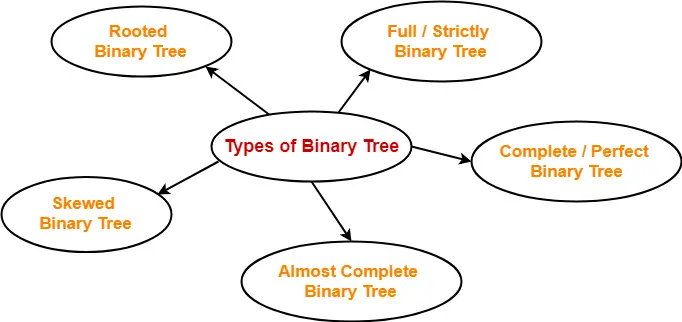
- Rooted Binary Tree
- Full / Strictly Binary Tree
- Complete / Perfect Binary Tree
- Almost Complete Binary Tree
- Skewed Binary Tree
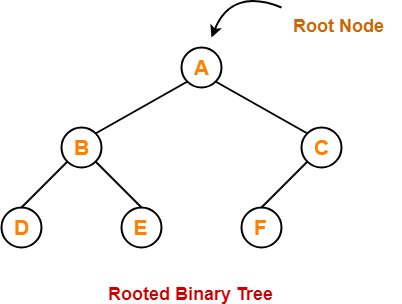
1. Rooted Binary Tree-
A rooted binary tree is a binary tree that satisfies the following 2 properties-
- It has a root node.
- Each node has at most 2 children.
Example-
2. Full / Strictly Binary Tree-
- A binary tree in which every node has either 0 or 2 children is called as a Full binary tree.
- Full binary tree is also called as Strictly binary tree.
Example-
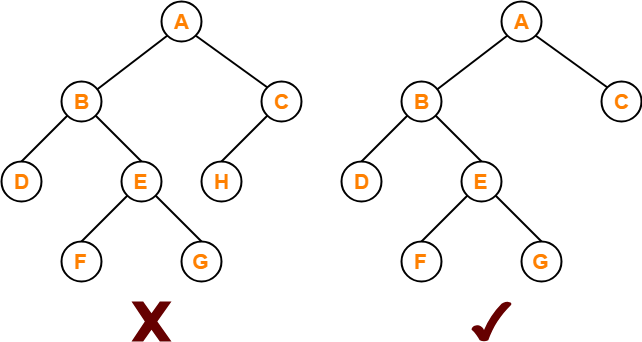
Here,
- First binary tree is not a full binary tree.
- This is because node C has only 1 child.

3. Complete / Perfect Binary Tree-
A complete binary tree is a binary tree that satisfies the following 2 properties-
- Every internal node has exactly 2 children.
- All the leaf nodes are at the same level.
- Complete binary tree is also called as Perfect binary tree.
Example-
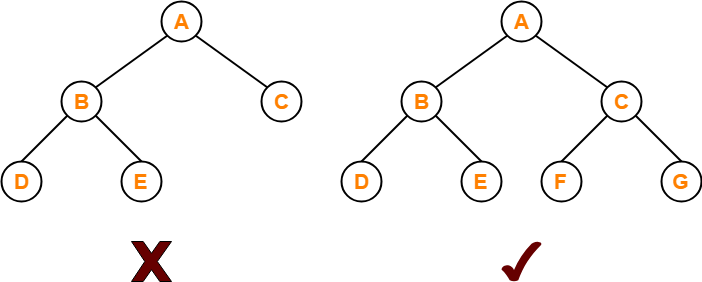
Here,
- First binary tree is not a complete binary tree.
- This is because all the leaf nodes are not at the same level.
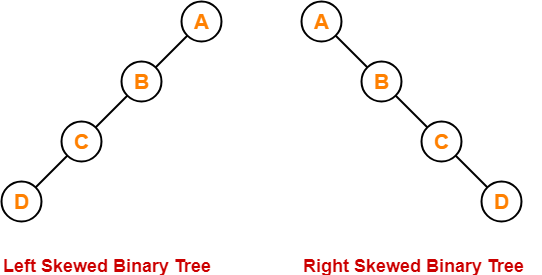
4. Skewed Binary Tree-
A skewed binary tree is a binary tree that satisfies the following 2 properties-
- All the nodes except one node has one and only one child.
- The remaining node has no child.
OR
A skewed binary tree is a binary tree of n nodes such that its depth is (n-1).
Example-

 Find Todays Notes